We Don’t Always Recognize a Good Idea When We See One
We think we’re pretty good at spotting great ideas, but research suggests otherwise. The most novel ideas can be the easiest to dismiss, especially when they’re still rough and uncertain. This post presents five ways to avoid killing a promising idea before it has a chance to prove itself.

History has shown us that even very smart people can struggle to recognize the potential of a great idea. Research suggests there are several reasons why we struggle to recognize great ideas when we see them.
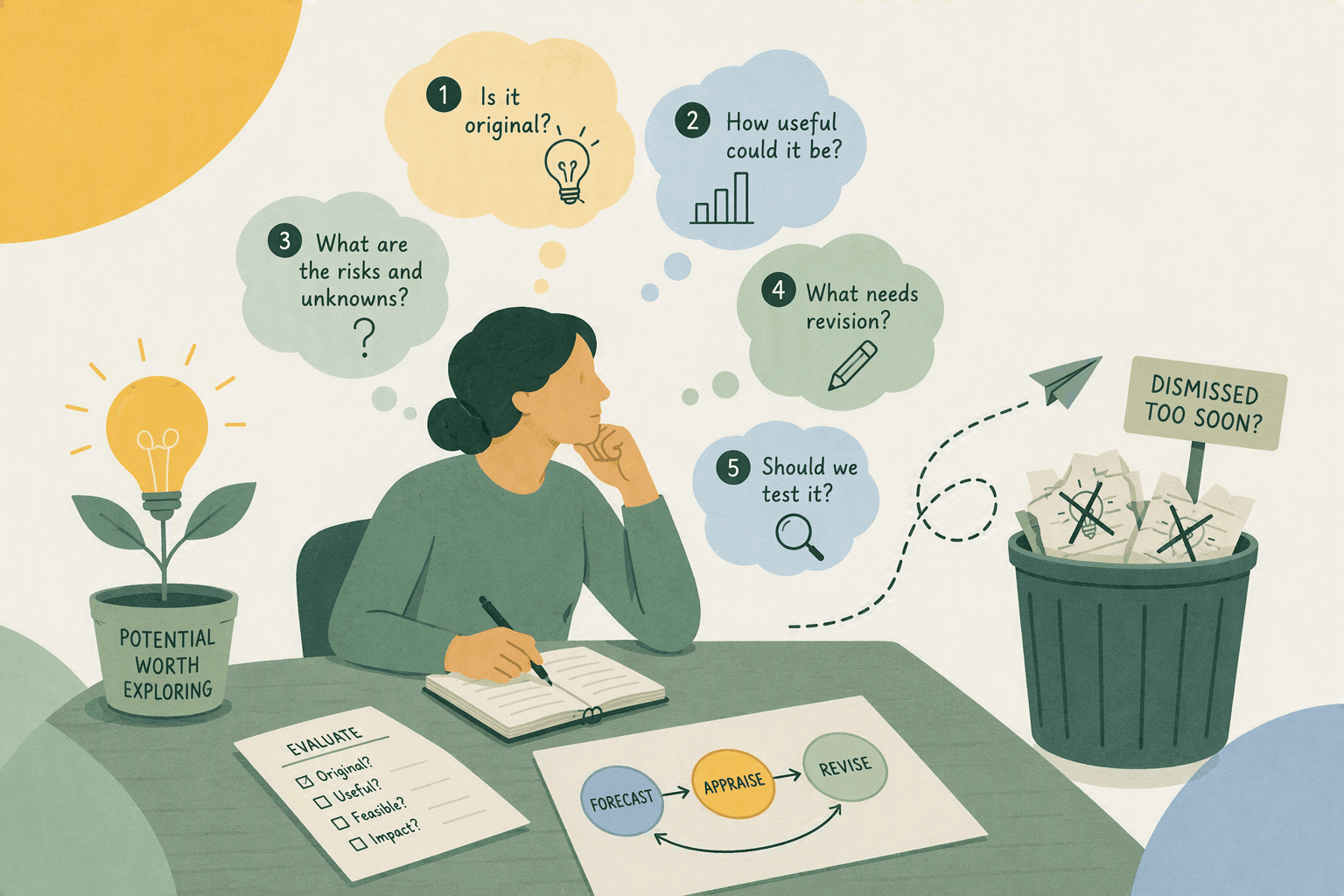
Picture yourself at your desk, considering ideas for solving a complex problem. Some have been brought to you by your employees. Others you’ve thought of yourself. Now you have to make a judgment: Which ideas should be rejected? Which need revision? Which are worth testing or pursuing? And among the promising ones, which deserve your time and attention?
Think we’re good at spotting the best ideas? We’re pretty bad at it.
We don't always choose our best ideas. In fact, some of the ideas with the greatest potential may be the ones we are most likely to dismiss.
History gives us plenty of examples. In 1876, an internal Western Union memo stated that the telephone had “too many shortcomings to be seriously considered as a means of communication”. In 1903, British politician Scott-Montague reportedly said, “I do not believe the introduction of motor-cars will ever affect the riding of horses” (van Wulfen, 2016). J.K. Rowling’s first Harry Potter manuscript was rejected by multiple publishers, and the potential of personal computers was not immediately obvious to everyone at IBM (Licuanan et al., 2007).
Now, I am not saying that every idea we reject is secretly a great one. We reject plenty of bad ideas each day, and often for very good reasons.
But history and research suggest that we may also be letting some genuinely promising ideas fall through the cracks.
Why We Miss Good Ideas
Here are some of the research-backed mistakes we can make when judging creative ideas:
- We undervalue originality. Highly novel ideas are often judged as less original or valuable than they actually are, creating a “so what?” reaction when an idea departs most from what already exists (e.g., Blair & Mumford, 2007; Licuanan et al., 2007).
- We favor what feels familiar. We tend to prefer ideas that are easy to understand, fit with existing schemas, and offer more obvious benefits, even when less conventional alternatives may have greater creative potential (e.g., Blair & Mumford, 2007; Todd et al., 2023).
- We tend to be risk averse. Ideas with uncertain outcomes or greater implementation risk are harder to embrace. Because highly original ideas often come with more uncertainty, we may reject them simply because we cannot confidently predict how they will turn out (e.g., Blair & Mumford, 2007).
- We treat evaluation as selection rather than diagnosis and revision. New ideas are often incomplete when they are first generated. If we treat evaluation as “keep or kill,” we risk eliminating ideas that could become much stronger through feedback and revision. Effective evaluation involves forecasting, appraisal, and revision (e.g., Mumford et al., 2002; Watts et al., 2017).
Put those tendencies together and you get a pretty effective recipe for killing promising ideas too early: we undervalue what is unfamiliar, shy away from what feels risky, and judge an unfinished idea as though it were already finished.
But there is an important counterargument.
Maybe skepticism isn't always a cognitive defect. Sometimes it is rational risk management.
A familiar idea has a track record. We know more about the likely costs, benefits, risks, and implementation challenges. A genuinely new idea may have none of that.
So when an evaluator says, “I'm not convinced yet,” they may not be making a mistake. They may be responding appropriately to uncertainty.
And that is where things get tricky.
Uncertainty can mean very different things.
An idea may lack evidence because it is unlikely to work. But it may also lack evidence because nobody has tried it yet.
That creates a difficult judgment call. If we demand evidence that can only be generated by actually testing an idea, we can end up rejecting the very ideas that need to be tested to determine their value. But if we start embracing novelty simply because it is novel, we have created a different problem.
The challenge, then, is not to become less skeptical.
It is to become better at distinguishing promising novelty from novelty that is merely unusual, particularly when ideas are incomplete and uncertainty is high.
How to Minimize These Evaluation Mistakes
The good news is that we don't have to rely on gut instinct alone. Research points to five strategies that can help us evaluate ideas more effectively.
I. Define your criteria first
Instead of asking, “Is this a good idea?”, separate the questions you are actually trying to answer.
What is original about it? How useful could it be? And what would need to be true for it to work?
II. Protect originality early
Before jumping immediately to what could go wrong, ask what is genuinely different about the idea and what new opportunities that difference might create.
If you evaluate novelty only through the lens of existing practices, you can end up penalizing an idea precisely because it does something different.
III. Forecast before deciding
Imagine actually implementing the idea.
What could go right? What could go wrong? What resources would it require? What barriers might emerge? How might customers, employees, leaders, or other stakeholders respond?
The goal is not to predict the future perfectly. It is to make the assumptions behind your judgement more explicit.
IV. Evaluate the idea’s weaknesses, not just its strengths
A highly original idea may need tougher questions about workability. A conventional idea may need a stronger challenge on whether it offers anything meaningfully new.
The point is to evaluate every idea against the same criteria, then use revision to strengthen the criterion on which the idea is weakest.
V. Revise before you reject
A weakness does not necessarily make an idea bad.
Sometimes the problem is not the underlying idea. It is one part of the idea that can be changed, strengthened, or tested.
Before you throw an idea away, ask: Can this be fixed?
That small shift matters because evaluation does not have to be the end of the creative process. In fact, the process is cyclical, and evaluation can often trigger further ideation.
The Real Skill: Knowing What to Do Next
The goal isn't to approve every unconventional idea. And it is not to become more optimistic about novelty for novelty’s sake.
It is to get better at recognizing what kind of decision we are actually making.
Sometimes an idea should be rejected.
Sometimes it needs to be revised.
And sometimes the smartest response is neither. It's to test it.
Because when we're evaluating ideas, we aren't just asking whether they are good enough now. We are also deciding whether they have enough potential to become good enough.
And this is where we'll go next.
In a future Research to Practice post, we'll dig deeper into what effective idea evaluation actually looks like, unpacking the roles of forecasting, appraisal, and revision and translating that research into practical strategies you can use when deciding which ideas to reject, revise, test, or pursue.
Found this useful?
Share it with your team or follow for more.
Get new insights delivered weekly
Join our community of practitioners who care about impact.
Or follow us on LinkedIn for daily insights