Three Myths Convincing You That You're Not Innovative
Decades of research contradict three common beliefs about creativity: that it arrives as a flash of insight, that it belongs to a certain kind of person, and that it only counts when it is disruptive. This post unpacks what the evidence actually shows and what it means for how you see your own work and the work of the people around you.

Picture a team meeting where someone floats the question everyone dreads: "We need some fresh ideas here. Who's got something?" Watch what happens. A few people glance at the one colleague with the reputation for being creative. Everyone else looks at their laptops. Later, in the hallway, someone will say it out loud: "I'm just not creative." Maybe you've said it yourself. Maybe you believe it.
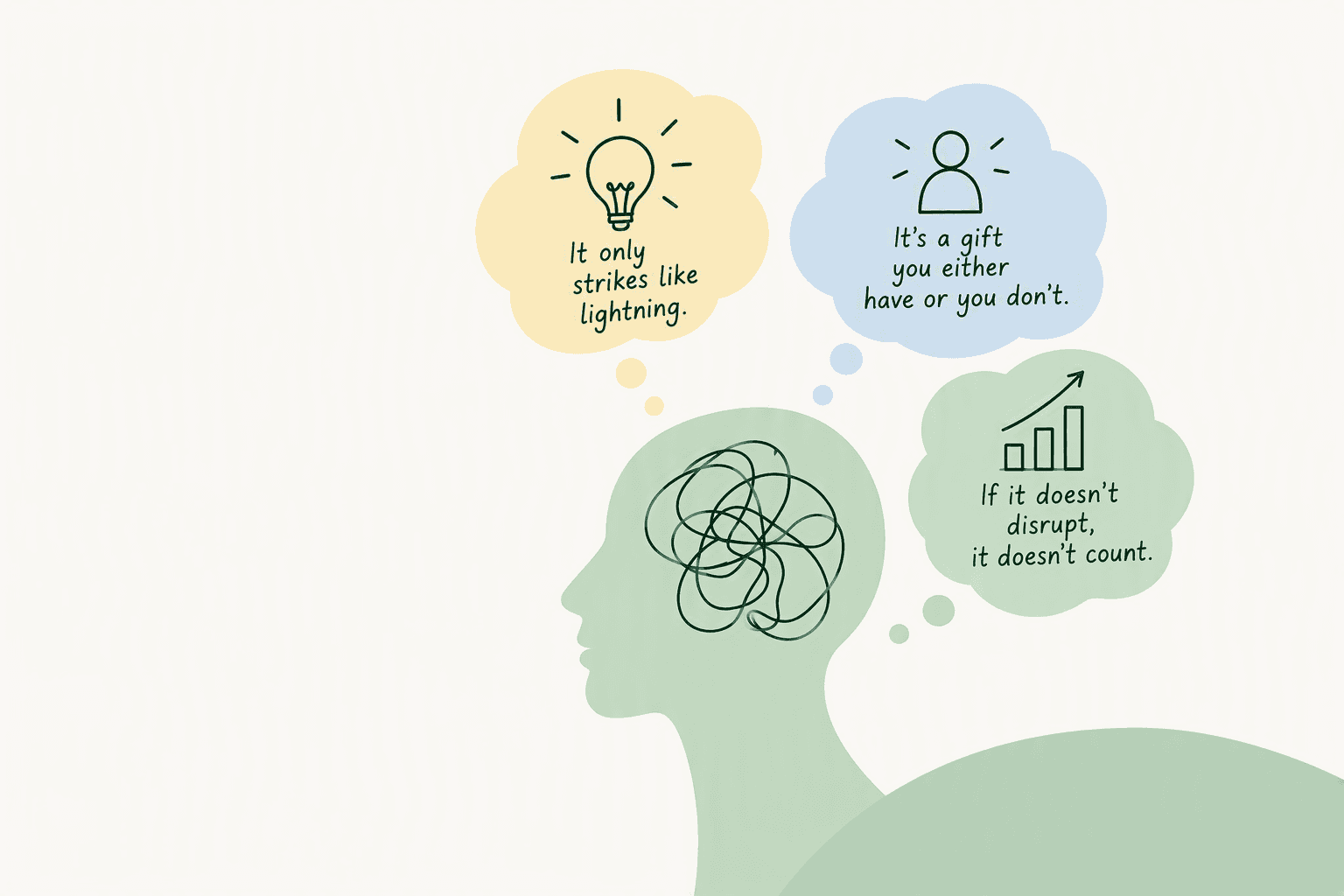
Here's what I want you to consider: that belief is not a fact about you. It's the product of a few stories society tells about creativity and innovation, stories so familiar we rarely stop to check them against evidence. When researchers have checked, the stories fall apart. But they do damage when people believe that innovation belongs to someone else. Someone struck by inspiration. Someone born with the gift. Someone building the next big disruption.
Myth 1: Innovation strikes like lightning
Insight can strike. But innovation is more than a moment.
You know this story because you've seen it a thousand times. It's the lightbulb that appears over a cartoon character's head. It's Archimedes leaping from his bath and running through the streets shouting "Eureka!". The story says creativity is an event. It arrives whole, unearned, and without warning. In a study of over 1,200 adults across six countries, 58% agreed that creative accomplishments usually result from sudden inspiration, and only 37% accepted that creative breakthroughs typically require ten or more years of deliberate practice (Benedek et al., 2021).
The research tells a different story. While moments of insight do occur, creative thought unfolds through cognitive processes: defining a problem, gathering information, combining concepts in new ways, generating ideas, evaluating them, and refining them through implementation. Those processes are cyclical rather than linear, and working through them takes time (Mumford et al., 1991; Mumford, 2000). Zoom out and the timescales get humbling: professional-level creative work in a field typically takes ten years of building expertise (Kaufman & Beghetto, 2009). And even a perfect idea is only the start, because researchers separate creativity, generating novel and useful ideas, from innovation, implementing them in an organization (Amabile, 1988). No lightning bolt can carry an idea into practice for you.
So the idea you're sitting on doesn't need to arrive finished before it's allowed to count. What people wait for, fully formed, defensible, done, isn't what creative work produces on the first pass. Creativity is iterative. It's process-based. It folds back on itself: defining and redefining a problem, generating ideas and revising them, combining pieces until they finally fit. If that's what it is, work it like one: find the actual problem before you reach for a solution, evaluate for what's novel and useful, and carry it into practice instead of stopping once you have the idea. Give yourself that grace, and give it to whoever's idea is still trying to take shape.
Myth 2: Creativity is a gift you either have or you don't
Not exactly. Certain traits matter, but they’re not the whole story.
The media gave this myth its face. Steve Jobs walks out in a black turtleneck and unveils what the future looks like. Mark Zuckerberg drops out of college and rebuilds how the world talks to itself. Each company gets treated as an extension of one extraordinary mind. Films sell a similar narrative, such as in Good Will Hunting, where a mathematical proof sits unsolved on an MIT hallway chalkboard until the janitor cleaning it at night solves it without ever having studied the material. Real founder or fictional janitor, the myth insists that genius lives inside a person.
When researchers look at what marks creative potential, the list is almost disappointingly unglamorous: curiosity, persistent interest, focused attention, self-discipline, deep knowledge of a domain, ambition, openness to experience, and a tolerance for risk to name a few (Mumford, 2000; Baas et al., 2013; Feist, 2006; Sternberg & Lubart, 1996). But the situation around us matters too. Creative performance tends to follow conditions that give those traits room to work: challenging problems, real autonomy, and colleagues or supervisors who treat a rough idea as worth building on rather than correcting (Oldham & Cummings, 1996; Hunter, Bedell, & Mumford, 2007).
Notice what that means. If you've concluded you're not creative because you don't resemble the movie version, you've measured yourself against fiction with the wrong ruler. Researchers describe creativity as the extraordinary result of ordinary processes (Sternberg & Lubart, 1996, p. 681), carried out by people with traits like curiosity and persistence, not some rarer gift. Chances are you have at least one of them. And those traits need somewhere to land. You can build pieces of the conditions that let them work, for yourself and for the people around you: push for the harder assignment instead of the safe one, treat a stalled attempt as information instead of a verdict, and ask for the time an idea needs before it's proven.
Myth 3: If it doesn't disrupt, it doesn't count
It counts. Innovation is novel, useful work on a real problem, and that happens at every scale.
This myth comes from work. Scan almost any strategy deck and you'll find it: we will disrupt the market, transform the industry, or break new ground. Disruption is what leaders picture when they ask for innovation. It's the word in the offsite slides, the pitch, the job posting. And the ask teaches everyone in the room a quiet lesson: if your idea won't remake the industry, it isn't really innovation. It's just doing your job.
But here's what the research actually says: innovation is novel, useful work aimed at a real problem, and nothing in that definition requires size, industry, or transformation (Mumford et al., 1991). Creativity itself runs on a spectrum, from someone's first personal insight to the eminent creativity of history's celebrated few (Kaufman & Beghetto, 2009). Sternberg (2005) describes a range of legitimate creative contributions, several of which work entirely within an existing way of doing things rather than replacing it. The business case backs this up: in a study of 141 R&D directors, the innovations tied to commercial success were mostly ones that built on and enhanced what a firm already did well, not ones that broke from it (Gatignon et al., 2002). Treating disruption as the definition doesn't raise the bar. It erases everything below it.
Yes, disruption matters. The innovations that remake an industry earn the attention they get, for good reason. But that's the version we've trained ourselves to recognize and talk about, when most of what moves a place forward is incremental: something built, then rebuilt, then rebuilt again until it's meaningfully better than where it started. That kind of innovation deserves the word too. Say it when what you built is only incrementally better, not just when it changes everything. Call it what it is when you watch someone else do the same. Recognizing innovation at every scale, in your own work and in the work of others, is what sets the stage for the transformational kind to happen at all.
Start With the Room You’re In
None of the three myths work alone. Believe the first, and you're waiting to be struck by something instead of building it. Believe the second, and you've already decided it won't be you who builds it. Believe the third, and even if you build something, you talk yourself out of counting it. None of this started with you. It's in the media, the movies, the founder profiles, and the language of strategy decks. But it doesn't have to end with you either. Stop carrying it yourself. Then build a room where nobody else has to either. Start with the one you're already sitting in.
Found this useful?
Share it with your team or follow for more.
Get new insights delivered weekly
Join our community of practitioners who care about impact.
Or follow us on LinkedIn for daily insights