GLP-1s: The Two Lives of an Innovative Breakthrough
Innovations have lives, and the most talked-about drug class in the world has already lived two. This post traces how GLP-1s were born through three different creative routes, how success redirected that same capacity toward defending the win, and why the difference shapes competition, timing, and access.

You haven't been able to escape them. GLP-1s are in the award-show monologues and the tabloid speculations, in the pharmacy shortage notices and the earnings headlines. You probably know someone taking one to manage diabetes, and someone else taking one to lose weight. By mid-2026, 11 percent of American adults were using a GLP-1 for weight loss, nearly four times the share from two years earlier (Witters, 2026). The two best-known brands brought their maker roughly 26 billion dollars in a single year (Walt, 2025).
Everyone knows the names, but most don't know the story behind them. And the story is better than the discourse, because the innovation holding society in a chokehold is a clear window into how innovation works: the different roads that lead to a breakthrough, the shared processes underneath them, and the way an innovation changes character once it succeeds. Innovations have lives, and this one has already lived two.
The First Life: Three Roads to the Same Place
GLP-1 isn't a drug; it's a hormone your gut releases after you eat, and the medicines named for it are a class, meaning several different drugs that work the same way. Byetta, Ozempic, Wegovy, Rybelsus, Mounjaro, and Zepbound are different molecules, made by different companies, all working through the same receptor. And they arrived by three entirely separate routes.
A Lizard in the Bronx
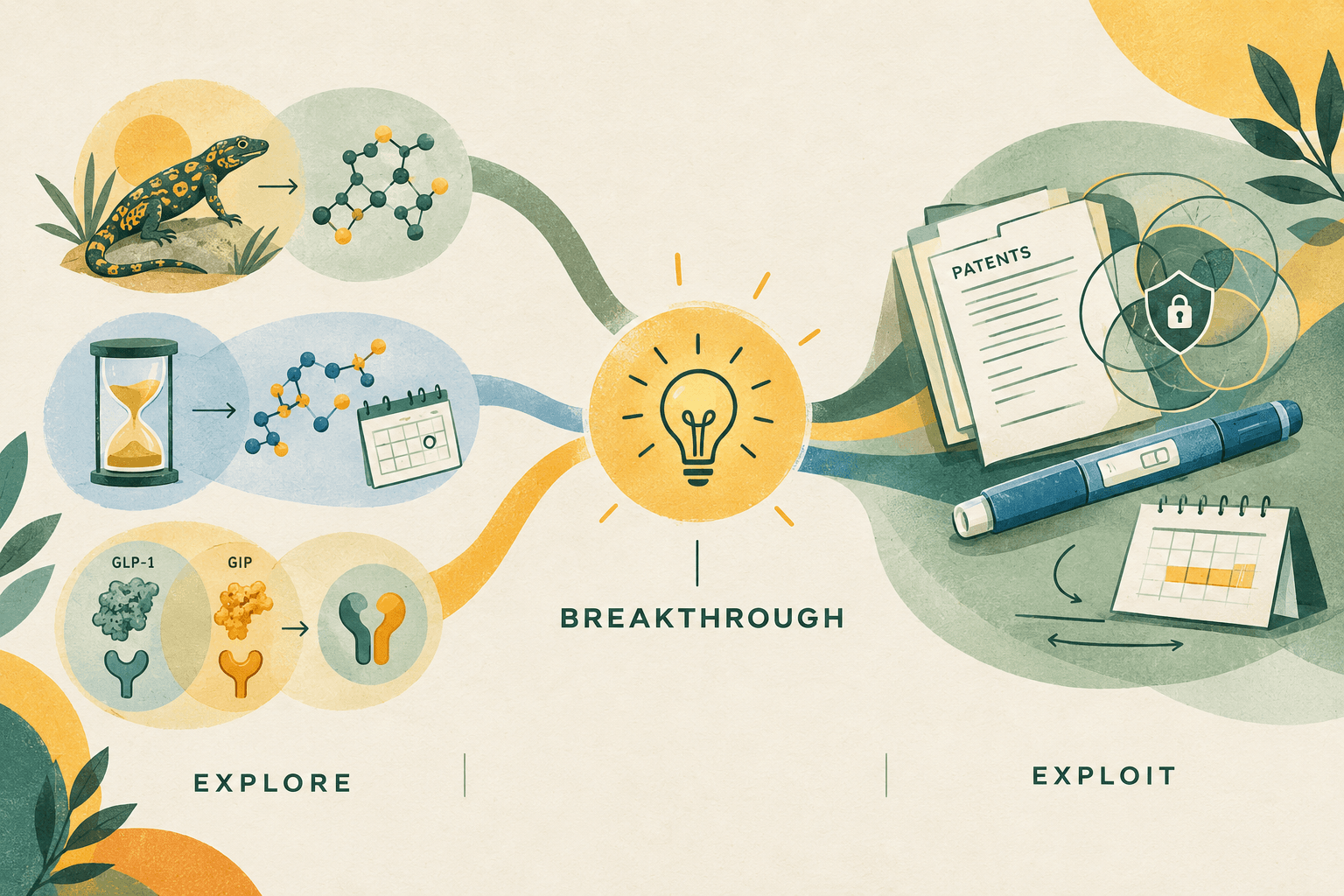
In 1990, an endocrinologist named John Eng was studying venom at a Veterans Affairs hospital in the Bronx. In the saliva of the Gila monster, a stocky desert lizard that eats a few large meals a year, he found a hormone that behaved like one your own gut releases after eating, the signal telling your pancreas to make insulin. Yours survives about two minutes in the bloodstream. The lizard's lasted for hours (Eng et al., 1992; National Institute on Aging, 2012). His molecule became exenatide, sold as Byetta and approved in 2005, the first drug in the class and the proof that this biology could be medicine at all.
The Two-Minute Problem
Novo Nordisk started somewhere else entirely, with the human hormone that already worked and the clock that made it useless. Two minutes was the obstacle. The company set out to rebuild the body's own signal to last longer, swapping amino acids and attaching a fatty-acid chain that let the hormone ride through the bloodstream on a protective protein. Two minutes became days, and a drug that would have required constant infusion became an injection once a week. That road produced liraglutide and then semaglutide, the molecule inside Ozempic, Wegovy, and Rybelsus.
Why Not Both?
Eli Lilly asked a different question. GLP-1 is not the only hormone your gut releases when you eat. A second one, called GIP, arrives alongside it and works on a different receptor. For years it was the less promising of the pair, with a tangled research history that made it look like a dead end. Lilly built a molecule that activates both receptors at once, pairing the hormone the field had settled on with the one it had largely set aside. The result was tirzepatide, sold as Mounjaro and Zepbound, two existing ideas fused into something new.
What These Roads Share
Told quickly, these stories sound like tales of good fortune. A lucky lizard, a clever bit of chemistry, and a hunch about a second hormone. But creative work leaves fingerprints, and the same ones show up on all three roads.
Every innovation starts with a problem, and these three started with different ones. Eng wanted to know why a lizard could go months between meals. Novo asked how to get past a hormone's two-minute lifespan. Lilly questioned what the field had stopped questioning, whether one signal was the right target at all. Those choices matter more than they appear to. How a problem gets constructed shapes the originality of everything that follows, and people who take time to define a problem in more than one way reach better solutions than those who move straight to answers (Mumford et al., 1991; Reiter-Palmon & Illies, 2004).
Once the problem is set, the question becomes where to look for an answer. Originality often requires reaching well outside the obvious and then recognizing that something distant maps onto the problem in front of you (Gick & Holyoak, 1983). How far you reach also shapes what comes back, because joining distant categories tends to produce the most original ideas, while joining closely related ones tends to produce the highest quality refinements (Mobley, Doares & Mumford, 1992).
Japan's bullet train got its nose from a kingfisher's beak, because the engineer running the tests was a birdwatcher who knew the bird enters water almost without a splash, and the noise that had capped the train's speed went away (Japan for Sustainability, 2005). The same curve holds at scale, where analyses of millions of patents show that reaching outside your own field improves the odds of a breakthrough up to a point and then begins to lower them (Briggs & Buehler, 2018). Eng's reach, from venom biochemistry to blood sugar, was the longest of the three, and it produced the drug that opened the field.
Team size shapes this too. Across 65 million papers, patents, and software products, smaller teams tend to produce work that displaces what came before, while larger teams tend to extend it (Wu, Wang & Evans, 2019). Neither is better, and a field needs both, one opening new directions and the other turning a direction into something that works, which is why teams working a problem from different angles raise the odds somebody arrives (Bessen & Maskin, 2009).
This Is Where the Story Usually Ends
The breakthrough happened, the patents were filed, and the credits roll on a satisfying innovation story. Except the discovery was only the first act. Innovations change character as they mature, and the work that follows a win looks very different from the work that produced it. In most industries that shift stays hidden, because a company protects a win quietly. A software company holds its position with speed, a manufacturer with know-how that took decades to build, a food company with a recipe nobody outside the building has seen.
Pharmaceuticals have none of that cover. A marketed molecule keeps no secrets, because any laboratory can read its exact structure. When researchers surveyed R&D leaders across roughly one hundred manufacturing industries, secrecy and lead time generally beat patents as protection, with pharmaceuticals the standout exception, the industry where the patent is very nearly the entire moat (Levin, Klevorick, Nelson & Winter, 1987). Success here expresses itself in patents, which means the second act gets written down in public.
The Second Life: Defending the Discovery
The patent record shows what came next. A Harvard team catalogued every patent covering ten GLP-1 products approved between 2005 and 2021 and found that more than half of what these companies listed with the FDA had nothing to do with the active ingredient (Alhiary et al., 2023, 2024). It covered the delivery devices: the pens, the injection mechanisms, the dose counters, the needles. Those layers should hold off competition for roughly eighteen years, several years longer than a brand-name drug typically manages.
That layering has a name. A patent thicket forms when protections pile up around a discovery until a competitor has to clear not one patent but a dense field of them, and the cost of trying becomes the real barrier. This is a documented pattern, not one company's habit. Secondary patents cluster on the best-selling drugs, tracking commercial value rather than scientific novelty (Hemphill & Sampat, 2012), and they arrive in a predictable order, substance first, then formulation, then device (Beall & Kesselheim, 2018). Humira, for years the best-selling medicine in the world, lost its original patent in 2016 and did not face an American competitor until 2023 (Gibbons et al., 2023). Those seven years were not an accident of paperwork. They were the product of sustained, skillful, legal work.
James March called these two modes exploration and exploitation. Exploration is search, variation, risk taking, experimentation, and play. Exploitation is refinement, efficiency, selection, and execution (March, 1991, p. 71). Play is an endocrinologist milking a lizard. Refinement and execution are the fourth generation of an injection pen. The drift from one to the other is not an accident, because success drives it, rewarding more of whatever just worked and crowding out the searching that produced the win (Gupta, Smith & Shalley, 2006). It works on people as reliably as on companies, since inventors coming off a successful run become more productive and measurably less likely to enter territory that is new to them (Audia & Goncalo, 2007).
None of this is an argument that one kind of work counts as innovation and the other doesn't. A better pen is real engineering, and for a drug people inject themselves with every week, the device matters to actual lives. What changes is not the legitimacy of the work but what shapes it. In the first life, the work was pulled forward by an unsolved problem, and the question was what might be possible. In the second, the strongest force is a date on a calendar, and the question becomes what can be protected, for how long, and against whom.
Why This Matters
Two consequences follow, and neither is obvious from the story alone.
The first is that a company's inventive capacity doesn't disappear after a breakthrough. It gets redirected. Effort spent extending a legal position is effort not spent on an unsolved problem, and an organization that has learned to protect might no longer be the one that goes looking.
The second is that layered protection doesn't only decide who competes. It decides when, and the waiting isn't free. Every year without a competitor is a year of brand pricing rather than generic pricing, paid by patients and the systems that cover them. And a field that one curious researcher could walk into in 1990 is now one that a competitor enters only by getting through everything built since.
An innovation isn't one event with one explanation. Different forces shape each stage of its life, deciding who gets to work on the problem, what form the answer takes, what it costs, and who can reach it. For a drug class this visible, we know remarkably little about what shapes it.
The Third Act: Still Being Written
A product is only what an innovation looks like from the outside. You've now seen this one from the inside, and the story isn't finished. Patents are beginning to expire around the world, protection is coming off market by market, and a field that spent two decades closing is about to open again to whoever wants to build in it. What a breakthrough becomes once it stops belonging to anyone is the next act, and it's being written right now.
Found this useful?
Share it with your team or follow for more.
Get new insights delivered weekly
Join our community of practitioners who care about impact.
Or follow us on LinkedIn for daily insights