AI Is Not Innovation. It Is a Tool That Can Help or Hinder Creativity.
AI can match or exceed average human creativity. But can AI, on its own, produce the kind of creativity that drives meaningful innovation? Research reveals surprising limitations, from its struggles with breakthrough ideas to its tendency to generate similar solutions, raising important questions about whether AI alone can deliver a competitive advantage.

Think about the internet. When it first showed up at work, there was plenty of resistance and no shortage of concern about whether it belonged there. Today, how many of us do our jobs entirely without it? Nobody asks whether you use the internet at work anymore. The question that matters is what you do with it.
AI is heading down the same road. A few years from now, today's debates about whether it belongs in the workplace will probably sound as dated as arguing about email, and the real questions will be how, when, and for what. But widespread adoption is not the same thing as effective adoption. Our claim is simple: AI is not innovation. It is a tool, and like any tool it can be used innovatively or not.
Vinchon and a group of creativity scholars (2023) mapped out the broad ways AI can enter creative work. People can create without AI at all, which is good old-fashioned organic creativity. They can lean on AI-generated work and present it as their own. They can gradually stop engaging in creative thinking and hand the whole process over to the tool. Or they can genuinely collaborate with AI, each contributing something the other could not. Only that last path treats AI as a tool for innovation rather than a substitute for it. To see why, let's look at what the science says AI can and cannot do on its own.
Thanks for being average?
Creativity is not just generating ideas. It is a process that runs from defining the problem through generating, evaluating, and implementing solutions, and AI might be strong at one stage and weak at another. Research across those stages is still developing, so let's start where the evidence is deepest: idea generation.
Give AI and a person the same idea generation task, and AI does very well, depending on which person and which task. Medeiros et al. (2025) and Haase and Hanel (2023) found no meaningful difference between GPT-generated creativity and average human creativity. Newer models do even better. Marrone and colleagues (2026) found that while GPT-3 did not generate more creative ideas than humans, later models produced a wide range of ideas scoring above the human average. Costello et al. (2024) found that GPT-4 outperformed average participants on idea quality and novelty, and Koivisto and Grassini (2023) found that AI beat humans on average at generating alternative ideas.
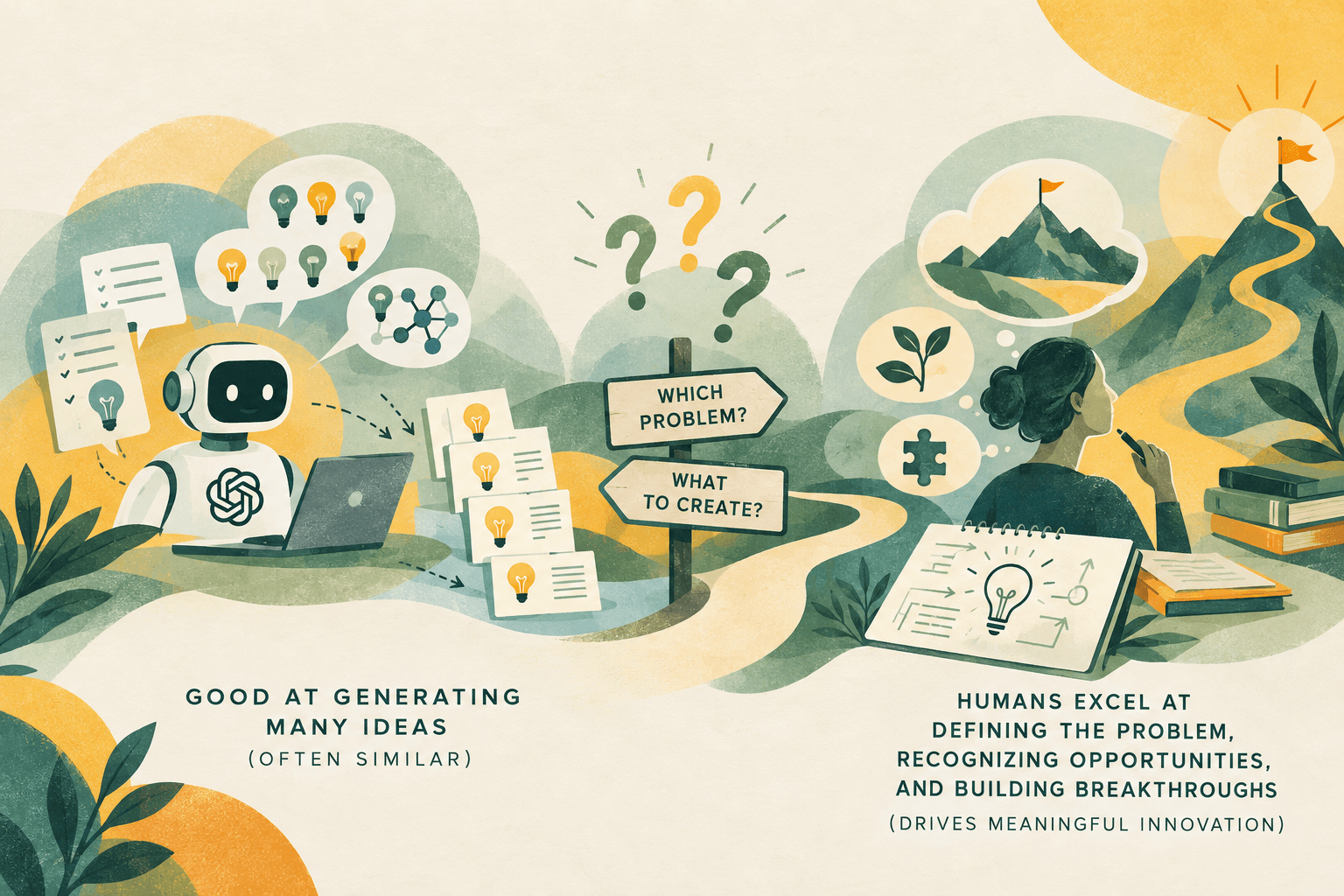
Impressive, right? But look at the word that keeps showing up in those findings: AVERAGE. In that same Koivisto and Grassini study, the best human ideas still matched or exceeded the best ideas AI produced, so AI's edge over the typical person did not carry over to the most creative people in the room. There is a second catch, too, and it has less to do with who is being compared than with what they are being asked to do.
AI is great when we hand it the problem
Charness and Grieco (2025) gave people and AI two very different creative tasks. In the first, the challenge was to write a creative story using ten specific words: house, zero, forgive, curve, relevance, cow, tree, planet, ring, and send. In the second, the challenge was to imagine you could invent anything simply by thinking about it, and to say what you would create and why.
Notice the difference? The first task hands you the problem and its constraints, and your job is to be original inside them. The second asks you to decide what is worth inventing in the first place. AI outperformed humans on the constrained task, and humans outperformed AI on the open one.
Anyone who has worked on something real will recognize this. Most hard problems do not arrive as neatly defined prompts. Often the most valuable creative contribution is noticing an opportunity nobody else has seen, questioning an assumption everyone takes for granted, or redefining the problem entirely. Marrone and colleagues (2026) caution against assuming that AI's strong performance on idea generation tasks carries over to these complex, real-world problems. AI is very good at answering the question it is given. Deciding which question to ask is still our job.
The kind of creativity being measured matters as well. Kaufman and Beghetto (2009) distinguish everyday creativity, like finding a clever way to organize your week, from professional creativity, which grows out of expertise and sustained work in a field. Most of the tasks in these studies sit closer to the everyday end, while the creativity our jobs ask of us sits at the professional end. Ding and Li (2025) found a related pattern, with generative AI appearing better suited to incremental discoveries in a given field than to fundamental ones built from scratch.
So, yes, AI can generate impressive ideas, often faster and more cheaply than we can. Which raises an obvious question. If it can produce ideas as creative as ours, or more creative, why not just let it do our creative work?
Well, well, well. Hold your horses, because the research has a couple of plot twists in store.
Plot twist #1: The tool leans toward the obvious
Cropley (2025) offers a useful explanation for this pattern in a paper with the clever title "The Cat Sat on the...?" His starting point is that creativity requires two things at once. An idea has to be novel, meaning original or unexpected, and effective, meaning useful for the problem at hand (Runco & Jaeger, 2012). A useful but obvious idea is not very creative, and neither is a wildly original idea that makes no sense. The magic happens when an idea is both.
Now think about how Generative AI tools like ChatGPT work. At their core, they predict which words are most likely to come next, based on patterns in everything they were trained on. Ask one to finish "the cat sat on the..." and it will say "mat," because that is the most probable answer. Cropley argues that this creates a built-in tension. When the tool goes with the likely answer, the result makes sense but is predictable. When it reaches for less likely answers, the result gets more surprising but also less coherent and less useful. It is hard for the tool to be both at once, which is exactly what creativity requires. This is a theoretical argument rather than a tested limit, but it helps explain why AI might be extremely effective at producing plausible creative ideas without necessarily being equally capable of producing the extraordinary breakthroughs that redefine what is possible in a field.
But perhaps you are thinking that none of this applies to you. You are not trying to win a Nobel Prize. You just need a creative campaign for your product, and if AI can produce something good enough, why not use it? That is a fair question, and it brings us to what may be the more important twist.
Plot twist #2: Everybody gets a similar answer
Suppose you need a campaign that makes your brand stand out. You ask AI for ten creative ideas, and within seconds you have clever slogans, engaging social media concepts, and a few strategies that really are good. You pick your favorite, build it out, and launch it. Success, right? Well, maybe.
Now suppose five of your competitors did exactly the same thing. They used similar tools, asked similar questions, and received remarkably similar suggestions. Each campaign looks creative on its own, but when customers see them side by side, none of them stands out. This is not just a thought experiment. Liu and colleagues (2025) observed this pattern in a study of digital marketing strategies.
That is a real problem for innovation, because so much of its value comes from differentiation. We innovate not simply to make something new, but to create value in ways others have not yet figured out how to copy. When the tool helping you generate creative ideas is helping everyone else generate similar ones, that advantage gets thin quickly.
The pattern reaches well beyond marketing. Across creative writing, scientific work, and other kinds of idea generation, studies by Anderson et al. (2024), Chen and Chan (2024), Doshi and Hauser (2024) and Wenger and Kenett (2026), among others, point to the same concern: AI-assisted outputs can become more similar to one another even when each one is rated as creative on its own. Because AI draws on patterns in its training data, it may favor familiar combinations and culturally dominant perspectives, narrowing the range of ideas on the table (Garcia, 2024). In other words, this is Cropley's argument at a larger scale. The tool pulls each of us toward the probable answer, and when we all use it the same way, it pulls us toward the same probable answer together.
The hidden cost of being creatively average together
Picture what this looks like from the inside. Everyone on your team starts using AI. You all produce more ideas, you produce them faster, and your individual work might even be rated as more creative than before. By every measure anyone is tracking, things look great.
But if all of those ideas are drifting toward the same place, the team ends up with less to choose from, not more. This is the paradox at the center of the research: AI may raise individual creativity while shrinking the diversity of the ideas we produce collectively. And a wide range of perspectives is often exactly what lets us find the opportunities everyone else walked past.
None of this is inevitable. AI can also help us explore unfamiliar perspectives, challenge our assumptions, and widen the set of possibilities we consider. The difference lies in whether we ask it to think for us or to help us think further.
The tool is not the advantage
Go back to the internet for a moment. Having it was never the advantage, because most working people had it eventually. The advantage came from what people did with it that others did not think to do.
The research suggests AI will work the same way. If we use it to stand in for our creative thinking, whether by passing off its work as our own or by gradually tuning out of the creative process, we will get output that looks creative and ideas that look a lot like everyone else's. If we use it as a genuine collaborator, the kind of partnership Vinchon and colleagues described, it may help us reach places neither of us could get to alone. What the science says about making that collaboration work is a big enough question that we will save it for an upcoming post. For now, the takeaway is this: AI is a tool, and innovation still depends on who is holding it.
Found this useful?
Share it with your team or follow for more.
Get new insights delivered weekly
Join our community of practitioners who care about impact.
Or follow us on LinkedIn for daily insights